
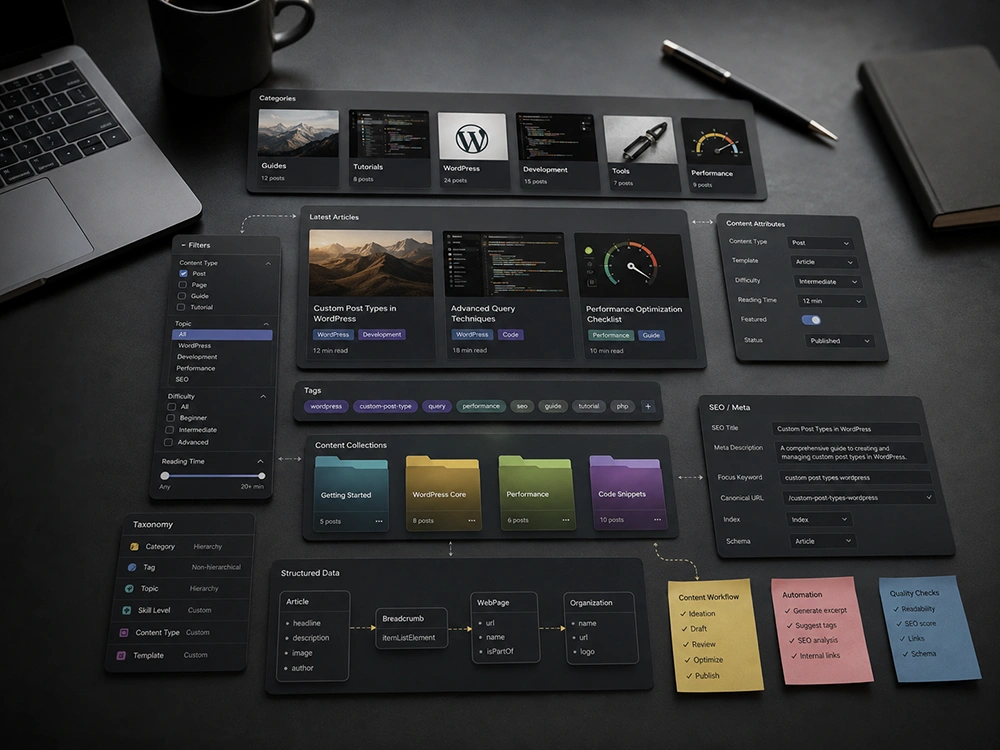

One thing I've noticed after working on different WordPress websites is that creating the actual content can sometimes take much longer than building the website itself.
You can spend hours getting the design right, setting up the products, creating custom fields, making filters, fixing the responsive layout...
And then you get to the point where you actually have to add the products.
That's when the fun starts.
Imagine you're building a website for a company that sells industrial equipment. They have 100 different products, each with different specifications, sizes, materials, applications and features.
For every product, you might have to choose its category, add attributes, write a description, fill in custom fields, add tags, write an SEO title, write a meta description, find keywords, upload images, and make sure everything follows the same structure as the products you added before.
Then you do it again.
And again.
And again.
At some point, you start wondering whether you're actually building a website or just filling out a very complicated spreadsheet.
The annoying thing is that a lot of this information is predictable.
If a website already has a clear niche and a defined collection of products, the system should be able to understand what those products are and how they relate to each other.
This is where I think there is room for a better kind of WordPress plugin.
What If the Website Understood Its Own Content?
Imagine installing a plugin on a new website and, instead of immediately asking you to create hundreds of categories and fields, it first looks at the website itself.
It could analyze the existing content, the products, the pages and the general topic of the website.
If it's an industrial equipment website, it should understand that.
If it's a furniture store, it should understand that too.
Then it could suggest a category structure that makes sense both for SEO and for the person actually using the website.
Not 50 meaningless categories just because they contain slightly different keywords.
A structure that actually helps someone find what they're looking for.
The same could happen with product attributes.
For example, if I add a new industrial pump and only provide its name and a few images, the plugin could recognize what kind of product it is and automatically assign the appropriate category and attributes.
Maybe it knows that this type of product normally needs:
Flow rate, pressure, material, power, voltage, application, connection size...
It could create or populate those fields in a consistent way.
And because those attributes are structured properly, they could later be used for product filters.
That last part is important.
AI generating a paragraph that sounds like it knows what a product is isn't particularly impressive.
Putting that information into the right fields, in a consistent structure that the website can actually use, is much more useful.
And Then There Is the Writing
This is probably the biggest time sink.
You add a product and then you have to write a product description.
Then an SEO title.
Then a meta description.
Then keywords.
Then maybe a short description.
Then image alt text.
Then you realize you forgot something and go back and edit it.
None of these things are particularly difficult.
That's almost the problem.
They're repetitive.
And they have to be done because content plays a huge role in how a website is understood and found across the web, even though most visitors will never notice the amount of work that went into producing it.
A customer doesn't look at a product page and think:
"Wow, excellent work on that meta description."
They just find the product, read it, and hopefully contact you.
So I think a good content-management plugin shouldn't just help you write faster.
It should help you avoid having to think about every little piece of content in the first place.
You could add the product title, upload a few photos, and let the system do the first pass.
It could determine the appropriate category, populate structured attributes, write the description, generate the SEO title and meta description, suggest keywords, and prepare the content in the format your website already uses.
You would still review it.
I wouldn't want a system that blindly publishes whatever AI generates.
But instead of starting with a completely empty product page, you would start with something that is already 80–90% there.
It Could Go Beyond Products
The same idea could work for blog posts and other types of content.
If the plugin understands the website's niche and the content that already exists, it could also help identify where a new article belongs, what topics it relates to, what internal links might make sense, and what information is missing from the website.
It could even suggest topics based on the gaps in the existing content rather than just generating random "10 Best..." articles because they're supposedly good for SEO.
And eventually, perhaps even generate or adapt product images where appropriate.
The goal wouldn't be to turn the website into a machine that endlessly produces AI content.
I think that would probably make the internet even worse than it already is.
The goal would be to remove the boring parts of content management.
The parts where you're not really being creative or making an important decision. You're just filling in fields because WordPress needs them filled in.
That's the part I think AI could actually be very good at.
A Different Kind of WordPress Automation
WordPress is incredibly flexible, but that flexibility also means that a lot of the work is pushed onto the person managing the website.
You create the categories.
You create the custom fields.
You decide which attributes products need.
You write the descriptions.
You organize everything.
You make sure the SEO information is there.
And then you do it all over again when the next product arrives.
I'd like to see a plugin that takes some of that responsibility away.
Not one giant "Generate Everything With AI" button, but something that actually understands the website and works within the structure you've created.
Because the future of content management, at least to me, shouldn't be about making us faster at filling out forms.
It should be about not having to fill out half of those forms at all.